
Secure ChatGPT Alternatives for Business: What to Evaluate in 2026
How to choose a secure ChatGPT alternative for business: 7 evaluation criteria, migration tips, and how Arkios delivers private AI chat for teams.
Here is an uncomfortable truth for most IT and security leaders: your employees are already using AI at work. They are pasting customer emails into consumer chatbots, summarizing internal documents with free-tier tools, and drafting proposals with whatever AI assistant they signed up for on a personal account. This is shadow AI, and it is happening whether your policy allows it or not.
The instinctive response is to ban consumer AI tools outright. In practice, bans rarely work. Employees who have experienced a 10x productivity boost do not quietly give it up — they switch to personal devices, personal accounts, and tools your security team cannot see. A ban does not eliminate the risk; it just removes your visibility into it.
The more durable answer is substitution: give your team a secure ChatGPT alternative that is as fast and capable as the consumer tools they already love, but governed, auditable, and grounded in your company's own knowledge. This guide walks through why consumer AI tools create real problems at work, the seven criteria that should anchor any evaluation, and what migrating a team actually looks like.
Why consumer AI tools are a problem at work
Consumer AI chatbots are excellent products. They are also designed for individuals, not organizations, and that design gap shows up in four specific ways.
Your data may train someone else's model. Many consumer AI tools use conversation data to improve their models unless users find and toggle an opt-out setting. When an employee pastes a customer contract or unreleased financials into a consumer chatbot, that content can leave your control permanently — and you are relying on each employee to configure opt-outs correctly on a personal account you do not manage.
No access control. Consumer tools have no concept of your organization. There is no way to say "marketing can use this, but the M&A team needs a restricted workspace," no way to provision or deprovision accounts when people join or leave, and no way to enforce which models or features are available. Every employee is an island, and offboarding means hoping they stop logging in.
No audit trail. If a regulator, customer, or your own security team asks "what company data has been shared with AI tools in the last six months?", the honest answer with consumer tools is: nobody knows. There is no log to review, no record of who shared what, and no way to investigate an incident after the fact. For organizations subject to SOC 2, HIPAA, GDPR, or industry-specific compliance regimes, that is not a gray area — it is a finding waiting to happen.
No shared context. Consumer chatbots know nothing about your company. Every employee re-explains your products, policies, and terminology in every conversation, gets answers that are generic at best and confidently wrong at worst, and the resulting knowledge stays locked in personal accounts instead of compounding across the team.
None of this makes consumer AI tools bad. It makes them the wrong tool for company data — the same way a personal Gmail account is not the right place for customer records.
The evaluation checklist
There are a growing number of enterprise AI chat platforms, and most vendors use similar language on their websites. These seven criteria help you cut through the marketing and compare options on substance.
1. Zero data training guarantee
This is the non-negotiable. The platform must contractually guarantee that your prompts, files, and conversations are never used to train AI models — not the vendor's models, and not the underlying model providers' models. Look for this in the terms of service and the data processing agreement, not just the marketing page. If a vendor hedges with "by default" or "in most plans," keep asking questions.
2. Encryption
Company conversations will contain strategy, customer data, and personnel matters. Confirm that data is encrypted in transit and at rest, and prefer platforms offering end-to-end encryption so conversation content is protected throughout its lifecycle. Ask where data is stored, who can access it operationally, and how keys are managed.
3. Role-based access control
An enterprise platform should mirror your org structure. That means role-based access control (RBAC): admins manage settings and users, team leads manage their workspaces, and members get the access their role requires — no more. Provisioning and deprovisioning should be centralized, so when someone leaves the company, their AI access leaves with them.
4. Audit logs
You cannot govern what you cannot see. Comprehensive audit logs — who accessed what, when, and what was shared — are what turn AI usage from a blind spot into something your security and compliance teams can actually review. If you ever face an incident or an audit, this is the feature you will be most grateful for.
5. Multi-model choice
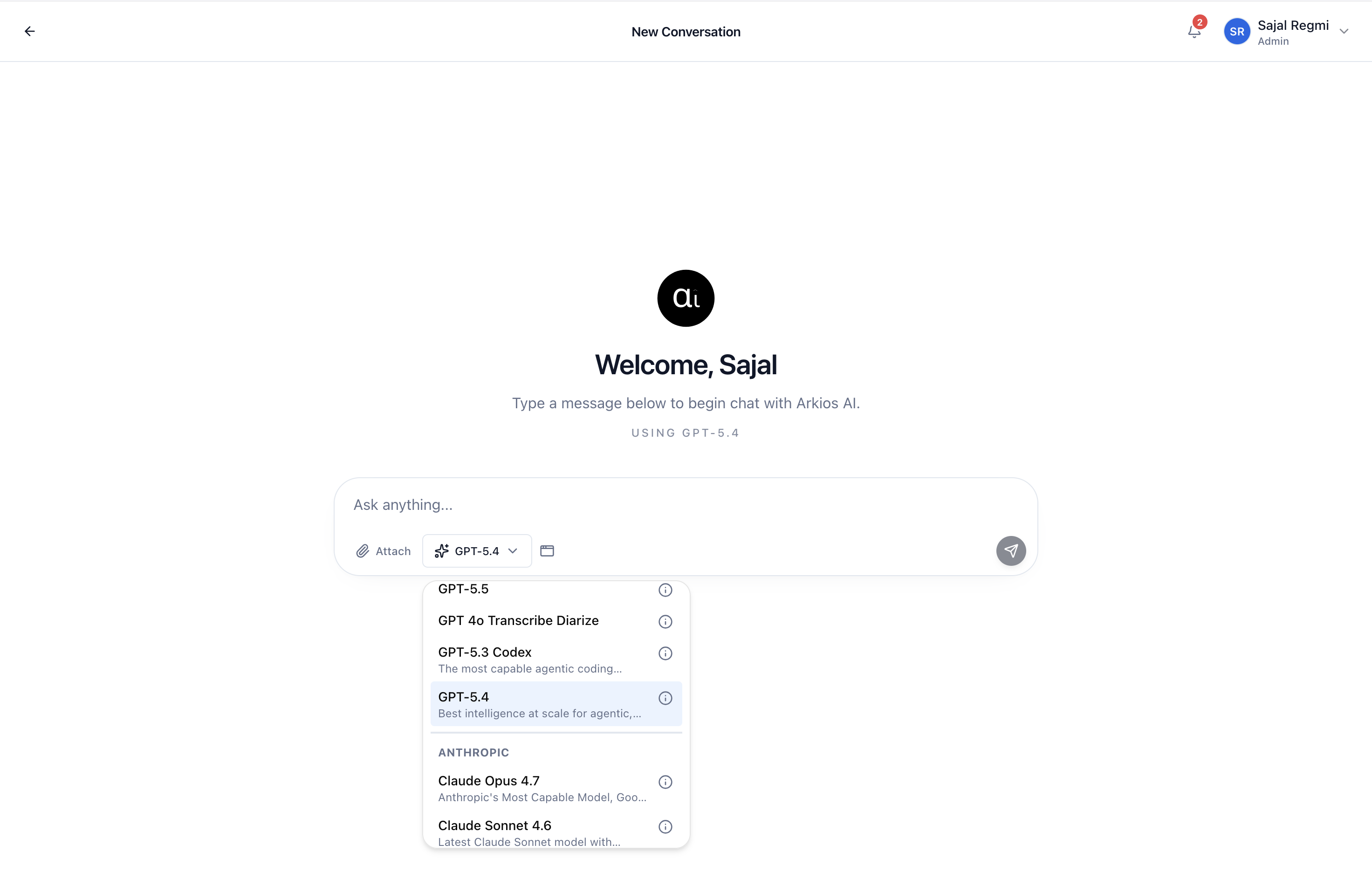
The AI model landscape moves fast. The best model for code generation, the best for long-document analysis, and the best for cost-efficient everyday tasks are rarely the same model — and the leaderboard reshuffles every few months. A platform locked to a single vendor's models locks you into that vendor's pricing, availability, and pace of improvement. Look for platforms offering 20+ models across providers, so you can route each task to the right model and adapt as the landscape shifts without re-platforming.
6. Grounding in company knowledge, with citations
Generic AI answers are a commodity. The real value of enterprise AI chat is answers grounded in your documentation, policies, and institutional knowledge — with citations that show exactly which source each claim came from. Citations are not a nice-to-have; they are how employees verify answers instead of blindly trusting them, and how you keep hallucinations from becoming business decisions.
7. Predictable pricing
Usage-based AI pricing is notoriously hard to budget. Token-metered bills spike when adoption succeeds, which puts finance in the absurd position of hoping employees use the tool less. Flat per-user pricing lets you forecast costs precisely, scale adoption without bill anxiety, and compare vendors on a like-for-like basis.
How Arkios approaches secure enterprise chat
We built Enterprise AI Chat at Arkios around this exact checklist, so it is fair to show our work against each item.
- Zero data training: Your prompts, files, and conversations are never used to train models. Full stop, contractually.
- Encryption: Conversations are protected with end-to-end encryption.
- RBAC: Role-based access control with team workspaces, so access follows your org structure and offboarding is a single admin action.
- Audit logs: Complete audit trails of platform activity, giving security and compliance teams the visibility consumer tools never could.
- Multi-model choice: Access to 20+ LLM models from leading providers in one interface, with streaming responses — no single-vendor lock-in, and no juggling separate subscriptions.
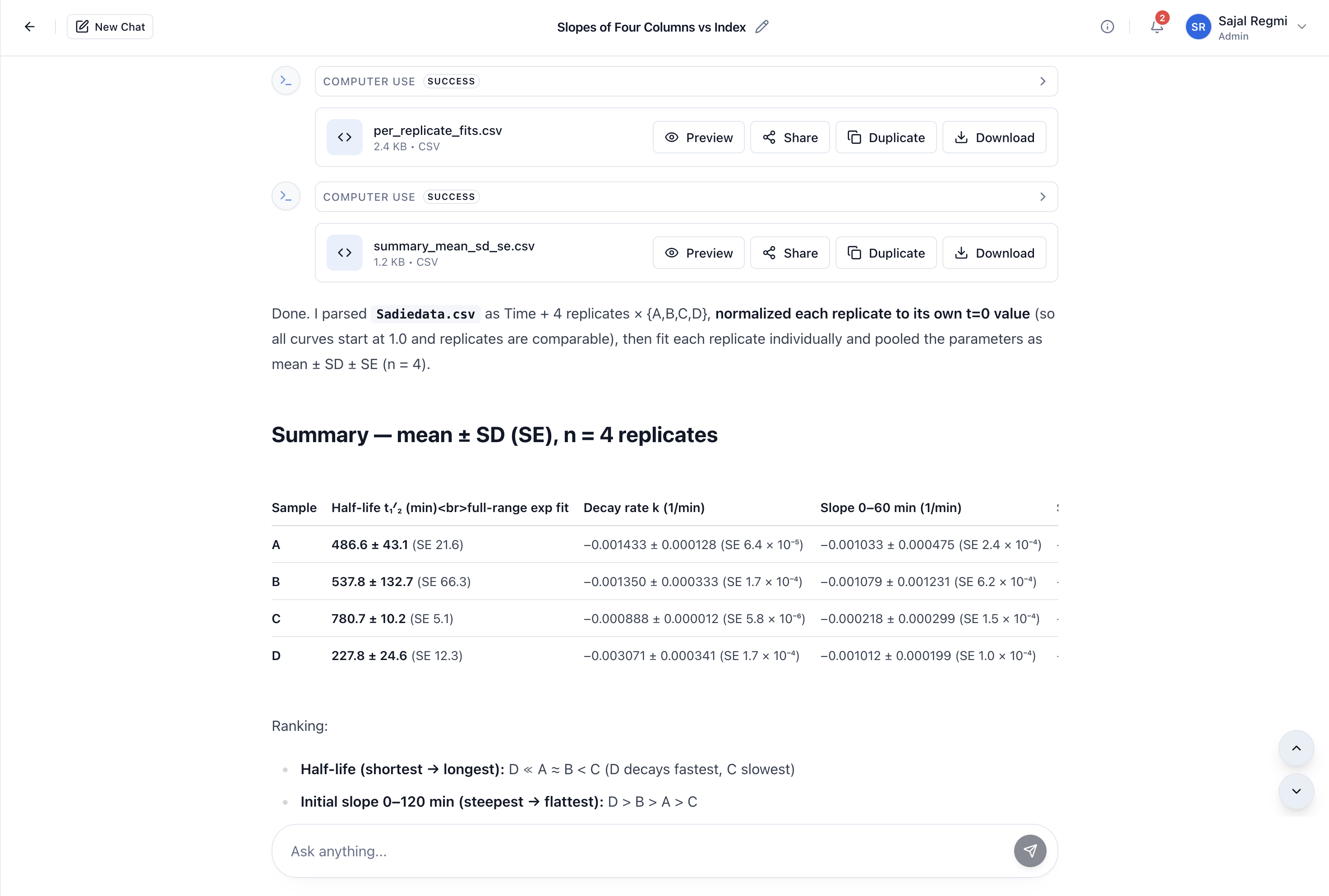
- Grounded answers: Upload files and connect company knowledge, and Arkios retrieves relevant context and answers with citations to the source. Conversation memory keeps context across sessions. The chat interface docs cover how retrieval and citations work in practice.
- Predictable pricing: $25 per user per month, flat. No token metering, no usage surprises. Details on the pricing page.
To be balanced: Arkios is not the only credible option in this space, and the right choice depends on your stack and constraints. If you are deeply committed to a single model vendor's ecosystem, that vendor's enterprise tier may integrate more tightly with its own tooling. If you only need API access for developers, a gateway product may suffice. Arkios is built for the organization that wants one governed chat platform for the whole team — multi-model, grounded in company knowledge, and priced so finance can sleep at night.
Migration tips: moving a team off consumer ChatGPT
Choosing a platform is the easy half. Moving people off tools they like requires some care. A few practical steps that work:
- Start with an amnesty, not an audit. Survey the team on what AI tools they currently use and for what. Make it explicitly blame-free — you need the real picture, and punishing honesty guarantees you will not get it.
- Pilot with your heaviest AI users. The employees already using consumer AI daily are your best testers and, if won over, your best champions. Give them the new platform first and act on their feedback quickly.
- Make the secure option the better option. Adoption follows utility. Load your key documents and knowledge sources before launch so the governed platform does something consumer tools cannot: answer questions about your business, with citations.
- Migrate prompts, not just people. Have early users collect their best recurring prompts and workflows and share them in team workspaces. This turns individual habits into shared assets and shortens everyone else's ramp-up.
- Set policy after the alternative exists. Once the team has a genuinely better option, a clear policy on consumer AI use becomes enforceable rather than aspirational. Pair the policy with the audit visibility to back it up.
- Measure and iterate. Track active usage in the first 60 days. Low adoption is a signal — usually missing knowledge sources or an unaddressed workflow — not a verdict.
For a deeper rollout framework, including stakeholder alignment and measuring ROI, see our Enterprise AI Adoption Playbook.
Frequently asked questions
Is there a secure version of ChatGPT for business?
OpenAI offers business tiers of ChatGPT with stronger data commitments than the consumer product. However, those tiers still limit you to a single vendor's models and ecosystem. A platform-neutral enterprise AI chat product like Arkios provides comparable security guarantees — zero data training, encryption, RBAC, audit logs — while adding multi-model choice and grounding in your company's own knowledge.
What is the best ChatGPT alternative for companies handling sensitive data?
The best alternative is whichever platform meets all seven criteria above for your specific compliance context: contractual zero-data-training, end-to-end encryption, RBAC, audit logs, multi-model access, cited answers from your own knowledge base, and predictable pricing. Shortlist two or three vendors, verify the guarantees in writing, and run a pilot with real (non-critical) workloads before committing.
Can employees still use their favorite AI models on an enterprise platform?
On a multi-model platform, yes — that is much of the point. Arkios provides access to 20+ models from leading providers, so an employee who prefers a particular model for writing or coding keeps that choice, just inside a governed environment with encryption, access controls, and audit logs.
How much does a secure ChatGPT alternative cost?
Pricing models vary widely, from per-seat tiers to usage-based token billing that can swing month to month. Arkios charges a flat $25 per user per month with all features included, and offers a 14-day free trial so you can validate fit with your own team and documents before paying anything.
Shadow AI is not a future risk — it is a present fact in most organizations. The companies handling it well are not the ones with the strictest bans; they are the ones that gave employees a secure, capable alternative before the habit hardened.
Ready to evaluate one? Start a 14-day free trial of Arkios — full platform access, 20+ models, your own documents, $25/user/month if you stay. Bring your evaluation checklist; we are happy to be measured against it.